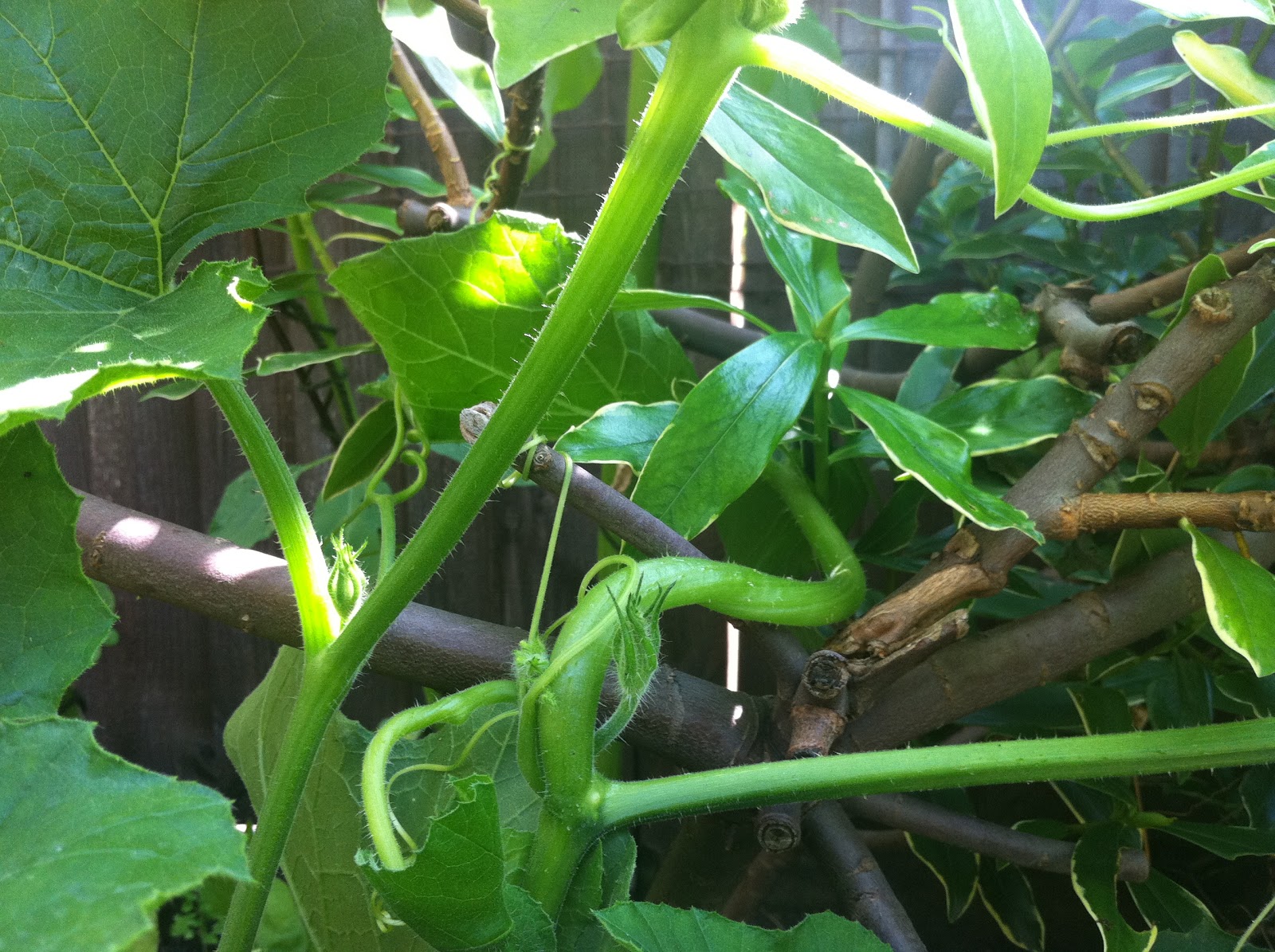
Showing posts with label squash. Show all posts

Sunday, 5 August 2012

Square foot gardening

A few months back when I was planning my veg plot I spotted an article about square food gardening in the Gardeners World magazine.  I was really inspired to try this and so divided my plot into 50cm2 squares.

Square 50cm2 gardening doesn't have the same ring to it but I'm a girl from the metric generation.

I grow something different in each of the squares depending on size.  I stick to crop groups for each square which lends itself to lots of space for crop rotations rather than big spaces being taken up for one crop type.  It can get difficult having most of the garden in favour of the tomato family (solanaceae) and the winter garden favouring brassicas and onion family but square foot gardening makes it all easier.

Generally I grow 4 varieties from a specific crop group - but it depends on the size of the mature plant.  For example rhubarb, squash and globe artichokes have their own 50cm2 square to themselves.  For roots I grow 4 types of roots in a square, the radish square is 3 different types of radish and some turnips, the onions have a slightly different take as I grow a few carrots in between the onions to help beat the pests. 

I think this method is more pleasing to the eye than rows, especially once the crops get established.  It has a higgledy piggledy view to the on looker (perhaps because of the close planting) but once you get up close you can see how everything is in its own individual zone.  It almost has a potager look about it.

Its easy to weed as well and as everything grows closely together you don't get so many - just a bit more weeding at the start while crops are establishing themselves. 

Interestingly in the mollusc invasion we had which accompanied the intensely wet weather - I didn't notice so much damage in the area where the square foot gardening method really took off.  It mainly took off with the plant groups heavily suited to our temperate climate. 

The mediterranean types didn't develop and so the weeds have dominated there - I've also had the most slug and snail damage in these areas.

Another method I tried in my new garden was the 3 sisters method.  I was growing squash at the base to suppress weeds and store moisture and these were grown at the foot of the beans.  I also grew sunflowers for the beans to climb but whilst the sunflowers were establishing (or desperately trying to survive in our disappointing weather) my boyfriend built climbing frames for them.  This was not the summer for trying such a thing.  The squash didn't grow big enough to over shadow the weeds and the sunflowers I was using in place of sweetcorn just got nobbled by the voracious slugs.

On a happier note, the squash are finally starting to grow now and I see the promise of baby fruit on some so all my efforts and feeding are (fingers and toes crossed!) not lost on my pumpkins and winter squash - they may still have a chance.

Have you tried any new planting methods this season?

Monday, 14 May 2012

May


I find May a tricky month.  She toys with us... gives us warm days but with lots of unpredictability to boot.

I've been reading fellow bloggers saying let May dance through your garden and that its the real start of growth in the gardening year, but for me, impatiently wanting to get my seedlings planted out... it's the month when I've suffered for my impatience the most.  Perhaps those bloggers were thinking of the cottage garden display rather than their veg patch!

If I were to think of a month I find exciting as a gardener it would be March.  You see the lush green shoots popping up everywhere but I'm not brave enough to plant my tenders out just yet because in all likelihood there are more frosts to come.

And the place I got bitten with May's unpredictability?  In London.  London's supposed to be free of frost by May, well certainly after the 15th May, but I've suffered windy weather which saw me making upcycled cloches out of plastic bottles.  Despite my ingenuity I was too late with one of my tenders - the wind snapped the main stem off a poor squash seedlings which killed it rather swiftly and left me with only one survivor.  I've also found temperatures dropping by 5 - 10 degrees in the latter half of May, again this was in London where it is supposed to be warm enough to put things out.  So many a fretful gardening experience in May.

I'd say err on the side of caution and wait til June where ever you are - unless you are feeling really brave.  I've had too many fretful times in the month of May.

I can't wait til June when I'll be finally planting my tenders outside.  However, I've recently moved 129 miles in a north westerly direction so I will try to be very restrained and wait until after the 7th June to get my veg plot fully populated.  Ah impatience, I know her so well!


Tuesday, 1 May 2012

Project New Veg Plot Continues


Half a month on from my last post about the new garden and the veg plot has been fully deturfed and the rhubarbs been slightly thinned out!  (It was a very scrummy rhubarb crumble)

We then had that really harsh wind storm and I thought the next door neighbour's eucalyptus tree was going to come down on our garden, it was being whipped around like it was a bendy twig.

I was very relieved I hadn't planted anything into the veg patch by then or I would have been watching my poor veg being destroyed by the winds from the upstairs window or worst still traipsing through the wind and the rain with all manor of contraptions to try and save my poor veg.  This has happened before, sometimes during rain storms in the middle of the night and now I don't plant my beloved squash until after the 1st June for that very reason!

As quickly as the wind and rain came, within about 6 hours they abated and the following morning we had a really warm spring day with sunshine and temperatures in the plastic greenhouse reaching nearly 30 degrees.

This was most definitely a gardening day!!  I turned all the soil in the veg patch to loosen it up and get some air in and added all the worm casts my wormery to offer (and some bits that weren't strictly quite ready to use!) to add a bit of nutrition to the soil.  I dug this in to the upper layer of soil and then raked the whole bed.

With time I won't dig the patch so much, using spent roots to rot into the ground and add their own nutrients and not digging were possible.  However, this patch of ground has been grassed over for what looks like a considerable amount of time, certainly a few years so my thoughts were to initially loosen the soil ready for the population of veggies that will soon find their home there.

I then popped in for a cuppa and a sit on the sofa.  All that exercise had made me tired!  But I was still in gardening mode and on a roll so I didn't want to stop when I sat down for a rest.  I reached for a pad of paper and drew up a plan.

The plot is roughly 4m x 2m and can be neatly divided into 6 rows.  There are planks conveniently stacked against the fence at the end of the garden which I will use to make my paths.  Each of these rows I will divide into 4 squares (about 50cm square).  I got the inspiration for this plan from the square foot gardening idea.

Today its windy and rainy again but I'm itching to plant some peas, carrots and spring onions and get this plot started!!

Maybe the surface needs to be raked once more before I'm completely ready... Patience is a difficult thing when you're itching to have your own crops growing in your back garden!

Tuesday, 27 March 2012

Insatiable Squash Grower

I think I am just going to have to accept it - I am a perennial squash grower.  Its a force that cannot be reckoned with.  Its a destiny that cannot be diverted... no matter what life throws in its way!

I am shortly to be moving house.  For this reason, this year I did not partake in the annual propogation of annual tenders like tomatoes, chillies and aubergines.  I put myself on pause for the simple reason that they would be difficult to move to another house especially a house move of such a distance as London to Birmingham.

So I denied myself one of my annual rituals.  I get so much pleasure patiently waiting until that day when the new seedling breaks through the soil and everyday after that grows and grows and grows.  I find it so exciting... it brings out the plant geek in me in a big way!

But this year I didn't do it.  I could read about you all doing it, Twitter was rife with it and I was deeply jealous at not partaking myself!

I thought I'd got over it.  Soon I would be able to do a late spot of propagation in April after our big move and all would be well... but alas, today when I was worrying over my wormery, redistributing food stuffs so all the trays will be a reasonable weight to transport in the move... I spotted what looked like a squash that's germinated all by itself....  I couldn't just leave it there to try and grow in the dark.  No doubt our recent heat helped things along for the little fellow.  So I planted him in a small pot.  Surely it will be OK to transport just one seedling?  It can travel on my knee to Birmingham.  Its only small!!!

I anticipate my boyfriend will say something along the lines of "Go on then" with that knowing look of the pains of having a plant geek of a girlfriend.

(Just between you and me I think he likes me cooking those home grown veggies for him though!)

Friday, 23 September 2011

Autumn Sunshine

Autumn has finally arrived to the garden here in South London, the squash leaves are looking tired, the sunflowers are starting to look a little sad with their bowed heads, lots of leaves to clear up off the patio and pots to spruce up.  Time for the autumnal tidy up!
Zapallito de Toscana (Cucurbita Maxima)

I love all these new gardening jobs as the summer season moves on to the next chapter of autumn.  The new light levels, the warm sunshine, spaces made where the summer crops have finished doing their thing, the garden is starting to look a lot less congested!  Whilst I absolutely love the jungle look that summer brings in our garden thanks to all the squash plants I like to grow I also love the new space that we get as autumn moves in.

Aubergine "de Barbentane" (Solanum Melongena)
And in the new spaces I've been busy sowing!  Winter radish, variety of turnip greens, peas for peashoots, tree onion bulbils (a perennial onion), onions from seed, Kai Lan and various winter salads.  I'm determined to keep the patio awake with edibles feeding us right through those cold winter months and into the hungry gap.

Against the south facing wall I have new spaces so have moved the sunloving herbs like rosemary, lavender, thyme, sage, marjoram and camomile which really seem to be enjoying their new home.

Citrus Lime (Citrus Latifolia Tahiti)
That's the beauty of the container garden, you can just keep moving your pots around through the seasons.

Another event in the garden is the migration of the heat lovers back inside the flat (chillies, peppers, the lime tree, the aloes...).  I keep an eye on their leaves and as long as they are not yet showing any sign of stress am letting them stay outside to make the most of any sunshine available.  However, I am keeping an eagle eye on the forecast and a daily check of these plants to make sure they are still happy outside.  Whilst we had a rather disappointing summer, we do seem to be blessed by a warm and gentle September.  As soon as those temps start to go towards 10 degrees C or below, I will find homes for the tender ones inside the flat.  I have a feeling that it might be a bit crowded indoors this winter!

Looking in my seedbox, the only month I can't find anything to sow is December.  Any suggestions?

Friday, 12 August 2011

Zapallito de Toscana

I'm growing a fabulous squash in my garden.  It's called Zapallito de Toscana and I got hold of the seeds from Garden Organic's Heritage Seed Library.

They were easy to germinate.  Well, easier than the courgette seeds.

They were strong seedlings.  I could tell that they would be feisty growers!

I planted these two seedlings out into their final planters with a courgette plant.


They are the perfect squash for a small garden as they grow in a bush style rather than the squash that like to crawl all over your garden.  They just need a decent depth of soil (like the planter in the picture).  They also would grow very well in potato planters.  Anything which allows them a good depth for their root run.

They are hungry feeders with a good appetite for water too.  Give them water whenever its not raining and feed them once a week with the richest feed you have (I feed mine with worm tea from my wormery) and in return they will reward you with many squashes.
One of the major benefits of this squash is even if you have a glut, you don't need to eat them or cook them all up at once as you would courgettes.  As they grow bigger they form a hard skin which means they can be stored and eaten into Autumn.

Another benefit is, when harvested they will have grown their seeds to a large enough size to be able to save them.  Just be sure to pollinate the fruit yourself to ensure the seeds are actually a Zapallito de Toscana.  In order to do this, I check the flowers at breakfast time and have a look for any open female flowers.  Once I've found one I hunt for an open male flower from the same plant or exactly the same variety, in this case another Zapallito de Toscana.  I pick the male flower and remove all the petals.  I brush the stamen (the male sex part of the flower) over the stigma (the female sex part of the flower) and then leave the stamen inside the female flower.  I then use an elastic band to shut the female flower to ensure no pollinating insects can get into the flower.  Once the flower starts to die away I move the elastic band on to the base of the fruit so that I can identify a fruit that I have pollinated.

The benefit of pollinating a squash plant is that it will ensure that the seeds you save will produce the squash you want.  Squashes cross pollinate very easily and you will probably get a mix of all the squashes with open flowers on a given morning being grown in your street or allotment.  You can never be sure what you will get.  Although, the experimenter in me would like to grow one of these insect pollinated ones just to see what I would get!  


So there you have it... Zapallito de Toscana...

1.  Great for a small patio garden due to its bush growing habit
2.  Grows fruits that can be eaten straight away or stored for later use
3.  Easy to save seed from (once pollinated by a gardener)
 
Squash recipes:
Courgette Humus
Good Summer Roast

More squash inspired garden blogs:
Gem Squash, the intrepid explorer
Passion for growning cucurbits

Monday, 1 August 2011

Gem Squash - The Intrepid Explorer


This year, I am trying to grow gem squash for the first time.

I was inspired to try growing them by some South Africans that I got into conversation with about 2am one morning.  We got onto the conversation of my passion of growing veg - a conversation that seems to occur rather regularly!!  Then they told me about a squash that was very readily available in South Africa but very difficult to find in the UK and they loved the taste of it.  They got the laptop googled "gem squash" to show me pictures of the squash.  Their enthusiasm for this vegetable inspired me and I added it to my seed wish list for this season's planting.

So now I have this lovely cucurbit growing in my back garden.

Its quite a small cucurbit plant.  The leaves are relatively modest compared to its neighbours. It is a cucurbita pepo and shares the same latin name as the courgette which is also a cucurbita pepo.
The gem squash germinated really easily with all seeds germinating.  It did try to keep them at around 18-20 degrees centigrade during germination and the soil moist not wet as cucurbit seeds do have a tendency to rot very easily if kept too damp.


Out of the 6 that I germinated, I kept 2 and gave the other 4 away to the community gardens I support through my Master Gardener volunteer role. 

I did notice early on that they were developing into rather small squash plants but soon they were clambering all over the place, and started to crawl up my landlords shrubs.


I was very proud.  I love opportunistic veg!

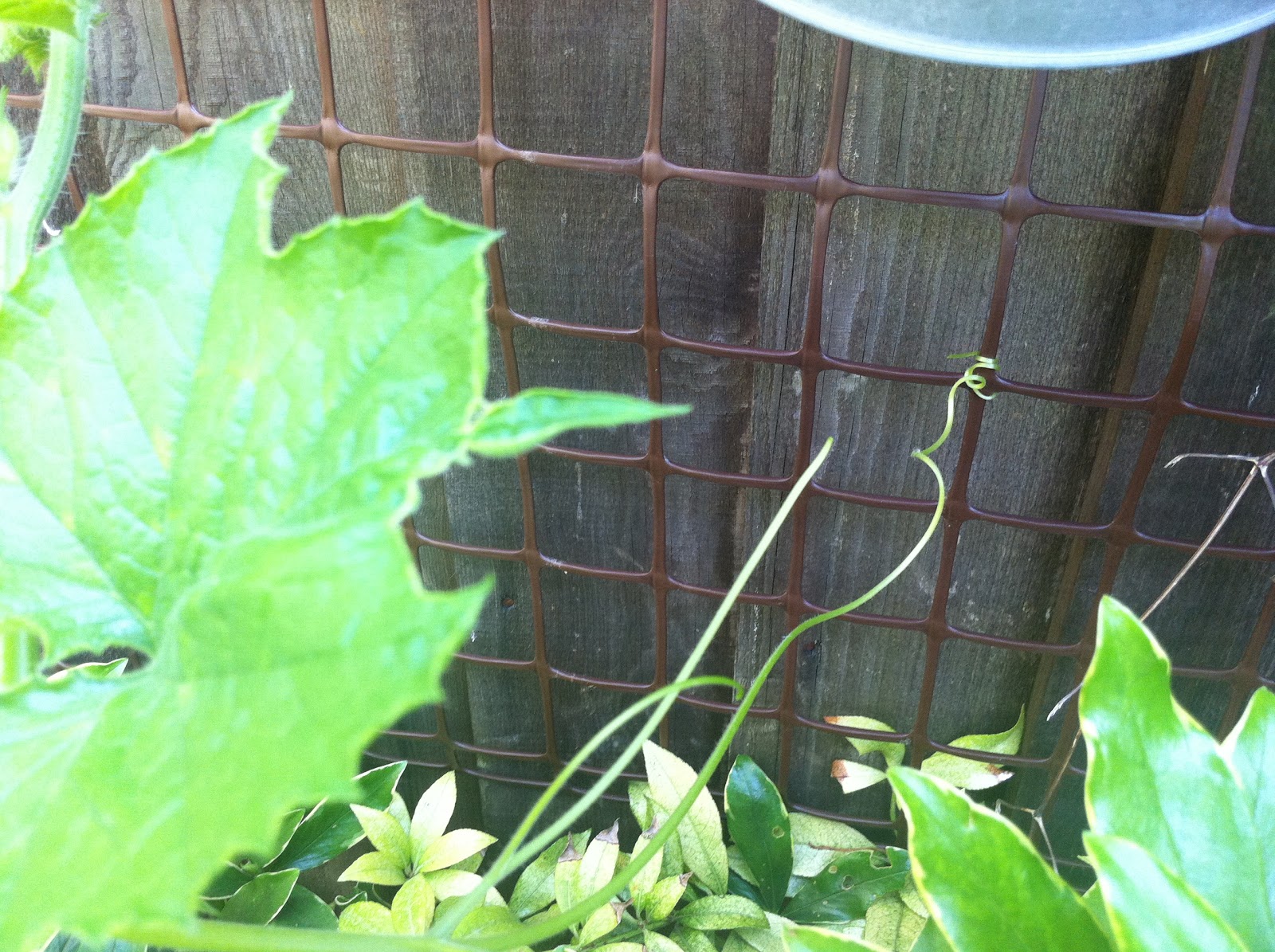
But this morning I noticed something even better...  The most gutsy out of the two plants has started to climb the netting on the garden fence.  Fantastic!!


I am really hoping that eventually they will start to climb the sunflowers... but we will have to see


I am really looking forward to cooking with their fruit, but until that time, they are certainly going to keep me very entertained with their climbing habits!

Friday, 10 June 2011

An ornamental edible garden


Lately I've been pondering a lot about the ornamental qualities of an edible garden.

It could be my work at the garden centre that has inspired me.

It could be due to planting a few companion flowers in the garden to ward off pests (e.g. calendula and nasturtiums).

It could be recently reading Alys Fowler's book The Thrifty Gardener - I could not help but read this gardening manual cover to cover!  This book inspired me to look at the garden as a combination of a thing of beauty and an edible garden.  Previously, I had always been focussed on growing edibles.  It really got me thinking about combining the two aspects, not just the plants but the containers that the plants live within.

Since then shopping has not been the same - always on the lookout for potential plant containers where ever I go and what ever I consume.  Take a look at what the radishes are growing in, in the picture below.


As well as hunting for potential containers this also led to my sowing a few annual ornamentals which I haven't really done before.  Cosmos was the ornamental flower that crept in - technically speaking the rest of the flowers are recommended companions for an edible garden.


I find rainbow chard with its full leaves and colourful stems always to be visually beautiful as well as very tasty.  Virtues of growing chard


Another vegetable that I have always thought very beautiful are squash.  I grew crookneck summer squash last year and the leaves looked so lush, the flowers and the bright yellow fruit looked amazing. Wonder of germinating squash


This year I have simply been completely bowled over by the beauty of purple pea varieties.  I think their flowers are simply astounding.  The flowers look sweet and no doubt their peas will taste amazing too.  I have never grown these before.  They came in this year's batch of seeds from the Heritage Seed Library called Purple pod.  Just take a look at how it flowers.  Peas please


I had almost forgotten to eat nasturtiums.  I've grown them for the last few years but simply as a fodder for the aphids so that they would leave my more prized edibles alone.


The other day I was gardening at the Bramford Community Garden and one of the other volunteers ate a nasturtium leaf.  The penny dropped - of course, you can eat the leaves! So I picked a nasturtium leaf.  Immediately, I smelt a very evocative smell that reminded me of a smell I knew from my childhood and with that smell I remembered the taste.  I thought why didn't I do this sooner!!  Munched on the leaf and that leaf packed a punch of peppery flavour.  Ever since then, nasturtium leaves have appeared in my daily salad!!  And the leaves and the petals are so beautiful too.


Last week I planted a Globe Artichoke in the Bramford Community Garden for its beautiful tall thistle shaped flower and its multi purpose of being a beautiful and architectural plant as well as an edible.  (Not the one in the picture!)  It is just a baby plant at the moment but I am looking forward to it growing taller than me with loads of beautiful flower heads!

Another thing of beauty is strawberry plants.  They come in a range of flower colours from deep dark pink, to pale pink through to the classic white flowers.  They can be planted in hanging baskets where the ripening fruit can dangle down graciously.


Take a look at these radish flowers. 


If I hadn't neglected the radishes last summer, I would never have seen this beautiful display of white flowers.  Following on from the flowers came the radish pods which were delightfully crunchy in salad (a bit like very small mange tout). 

Friday, 15 April 2011

The wonder of germinating squash


I love this time of year, the spring sunshine, signs of life springing up everywhere and our especially warm spring this year speeding all these activities by leaps and bounds.

Some things are faster and more eager than others... namely squash seeds.  Every year they surprise me at how fast they germinate and they never fail to amaze year after year.  Every child should try germinating squash seeds!  It awakens the child in me every year so it must be extremely exciting through a child's eyes.

This year I've planted 4 varieties and I'm not cautious on the quantities of seeds I am germinating either.  I am a Master Gardener for Garden Organic http://mastergardeners.org.uk/about/master-gardeners/ and as I support and advise 4 community food growing gardens, if I germinate too many for my garden, these community garden groups will be more than happy to take them and give them a home!

Back to the squash seedlings... the seedlings in the picture above germinated in just 3 days, now I think that's really impressive!!!  These guys really have a thirst for life.  If you have kids or want to awake the kid in you, I highly recommend giving the squash chaps a go!

The seedlings in the picture above are "Pattison Blanc" Patty Pan Squash a French heirloom variety available from Real Seeds, here's the link  http://www.realseeds.co.uk/courgettes.html

I am also germinating Heritage Seed Library Zapalliotode Toscana Squash which have dark green to purple fruits with orange pulp  http://www.gardenorganic.org.uk/hsl/variety.php?IdNum=688
Real Seeds "Striato d'Napoli" Courgettes which grows courgettes with an attractive green stripe http://www.realseeds.co.uk/courgettes.html
Gem Squash for my South African neighbours from Tozer Seeds and last but certainly not least Real Seeds "Crookneck" Summer Squash http://www.realseeds.co.uk/courgettes.html

I grew the Crookneck variety last year and just had to do it again - the bright yellow fruit look amazing on the plant:


and taste amazing in your cooking.


The other varieties I listed above I am trying for the first time this year.  Watch this space - progress reports on these will be sure to follow in the coming months.