Showing posts with label zapallito de toscana. Show all posts

Tuesday, 27 December 2011

2011 Gardening Year of Trials and Tribulations

What a challenge 2011 has been for us gardeners but with challenges comes resourcefulness and problem solving.

If we look back over the past year we've had an extremely warm start in spring with April reaching over 20 degrees centigrade.  In May, temperatures dropped (but I find they do most years so waited until early June to plant out the cucurbitaceae (squash)).  Then the summer didn't really come.  July was grey and wet through some of the weeks.  Then August came and didn't really bring summer either ending, certainly in the South East with a day of severe rain that swiftly followed with blight attack on many tomatoes (the community gardens and school garden I support suffered this more than my small patio garden).  In September as there were so many green tomatoes being given to me I learned to make chutney for the first time.  Followed by a crazy Autumn and really high temperatures in the first week of October when lucky people who hadn't cropped yet got a week's summer.  And now we are experiencing a rather warm winter - in fact, I'm not sure whether to call it winter at all.  Usually the nasturtiums have died off by now but my sheltered patio garden hasn't really felt the bite of a frost yet.

So a rather challenging year to garden in but his meant lots of adaptation and resourcefulness.

Early in the year my boyfriend bought me a plastic greenhouse.  It was absolutely fantastic for hardening off seedlings in early spring and I used it for this purpose from March all the way through to June.  For a few months I left it vacant, but I've really got into growing chillies this year and our summer wasn't really a good one for them so as the weather started to disappoint in July I started to move them into the plastic greenhouse - and they loved it!  I didn't even have to water them that much as they would sweat off the excess water and it would stay in the green house.  I continued to use it all the way through to October.  If you don't have one, and don't have the space for a glass green house I really recommend getting a plastic greenhouse!

In the summer I also started to use horticultural fleece.  I've never used this before, not even in the winter but I bought some by mistake when I was buying some horticultural mesh for my cabbages.

For ages it remained stored in its wrapper and then when I started to see flowers on my aubergines I had little hope of them bearing fruit and I thought about the idea of using the horticultural fleece.  It worked a treat!

Definitely using it next year, especially if I get impatient with my tomatoes!

This year I stumbled across a really good variety of winter squash that seemed completely unperturbed by our disappointing summer.  They are called Zapallito de Toscana and I ordered them from the Garden Organic Heritage Seed Library Catalogue.  I am definitely going to be sourcing more seed for next year.

It was the first year I grew from seeds sourced from the Heritage Seed Library and I had some absolutely beautiful purple peas. 


I wouldn't recommend them for crops to be grown in a container garden as they didn't really give enough of a yield but the flowers were beautiful and I just couldn't help take photos of them.

I would definitely recommend growing Heritage Seed Library varieties and to learn seed saving.  Its a great source of seed if you like to experiment with unusual or old heirloom varieties.

I tried seed saving for the first time this year and found it tremendously rewarding.

Next year, I am going to grow more varieties that are perennial/biennial and/or are low fuss to grow. Varieties I found to be in this camp this year were nasturtiums (plant them anywhere you have a spare bit of ground - you can make pesto, a little chopped leaves on top of curries, flavour for salads - they are truly wonderful and add colour to small plots), zapallito de toscana (winter squash), kai lan, chard, kale and herbs, salad potatoes...  

I am also going to introduce more early varieties of tomatoes as these will probably be more UK climate friendly.  I'll also look for early varieties of chillies, sweet peppers and aubergines as these could be more suited to the UK growing season too.

In 2012 I will be looking for more varieties to add to this list.  I am still trialling Egyptian Walking Onions and broad beans.

A review of gardening in 2011 wouldn't be complete without mentioning my wormery.  It provided me with wonderful worm casts and the garden benefited so much from the worm tea.  If I didn't have my own wormery I would pay for worm tea.  So much more superior than bought organic fertiliser.

Next year I plan to be far more savy in July and August with my winter planting.  Its lovely having things growing in the winter garden and I think you should be able to graze and browse your garden no matter what month of the year it is.  I still have some winter salad growing and brassicas in my garden.

I think it so important to keep a relationship with your garden no matter what season and that includes eating/grazing from it as many days of the year as possible!

Friday, 12 August 2011

Zapallito de Toscana

I'm growing a fabulous squash in my garden.  It's called Zapallito de Toscana and I got hold of the seeds from Garden Organic's Heritage Seed Library.

They were easy to germinate.  Well, easier than the courgette seeds.

They were strong seedlings.  I could tell that they would be feisty growers!

I planted these two seedlings out into their final planters with a courgette plant.


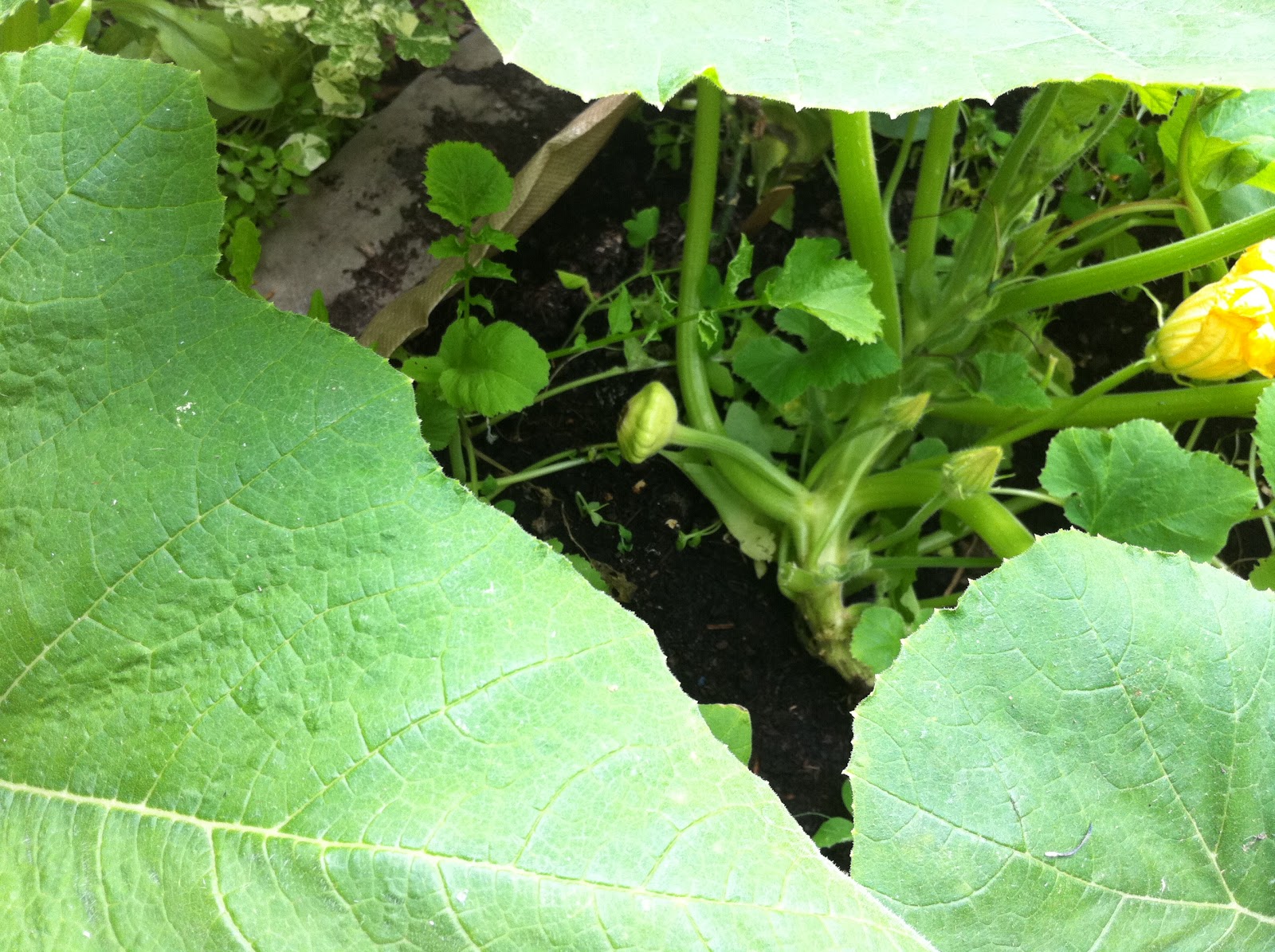
They are the perfect squash for a small garden as they grow in a bush style rather than the squash that like to crawl all over your garden.  They just need a decent depth of soil (like the planter in the picture).  They also would grow very well in potato planters.  Anything which allows them a good depth for their root run.

They are hungry feeders with a good appetite for water too.  Give them water whenever its not raining and feed them once a week with the richest feed you have (I feed mine with worm tea from my wormery) and in return they will reward you with many squashes.
One of the major benefits of this squash is even if you have a glut, you don't need to eat them or cook them all up at once as you would courgettes.  As they grow bigger they form a hard skin which means they can be stored and eaten into Autumn.

Another benefit is, when harvested they will have grown their seeds to a large enough size to be able to save them.  Just be sure to pollinate the fruit yourself to ensure the seeds are actually a Zapallito de Toscana.  In order to do this, I check the flowers at breakfast time and have a look for any open female flowers.  Once I've found one I hunt for an open male flower from the same plant or exactly the same variety, in this case another Zapallito de Toscana.  I pick the male flower and remove all the petals.  I brush the stamen (the male sex part of the flower) over the stigma (the female sex part of the flower) and then leave the stamen inside the female flower.  I then use an elastic band to shut the female flower to ensure no pollinating insects can get into the flower.  Once the flower starts to die away I move the elastic band on to the base of the fruit so that I can identify a fruit that I have pollinated.

The benefit of pollinating a squash plant is that it will ensure that the seeds you save will produce the squash you want.  Squashes cross pollinate very easily and you will probably get a mix of all the squashes with open flowers on a given morning being grown in your street or allotment.  You can never be sure what you will get.  Although, the experimenter in me would like to grow one of these insect pollinated ones just to see what I would get!  


So there you have it... Zapallito de Toscana...

1.  Great for a small patio garden due to its bush growing habit
2.  Grows fruits that can be eaten straight away or stored for later use
3.  Easy to save seed from (once pollinated by a gardener)
 
Squash recipes:
Courgette Humus
Good Summer Roast

More squash inspired garden blogs:
Gem Squash, the intrepid explorer
Passion for growning cucurbits

Friday, 29 July 2011

Passion for growing cucurbits


Every year I fall in love with my cucurbits all over again.  I've been growing 
them every year for the past 7 years.
 
I was living in Brixton in a shared house when my next door neighbour gave me 
some spare courgette seedlings.  She had noticed that I was out in the garden at 
every opportunity and that I was starting to grow vegetables.  She told me she 
knew they were going to a good home!
 
At first I tried growing them in a large pot but their leaves started to look a 
little sad so I planted it in the flower border.  It grew these big luscious 
leaves and lots of courgettes and contributed to my very first home grown hangover 
recipe!
 
In my second year as a courgette grower I grew one fruit that was over half a metre 
long - I know, I know, that's not really a courgette anymore!  It looked very impressive 
but didn't really taste great!!
 
Last year I started experimenting with other cucurbits.  I tried a crook neck squash 
which I sourced from Real Seeds.  They had bigger leaves than the courgette and the 
bright yellow fruit looked amazing.  They also cooked very nicely too.  I fried them 
and roasted them with very tasty results.  I grew them in grow bags and neighbours 
did ask how they were growing in such a small amount of soil but they did.  I think 
I'm quite attentive with lots of watering and feeding which makes them look all the 
more lush!
 
This year I'm growing 7 cucurbits in the 2 containers in the picture above. I am often
asked how they can grow healthily in such small containers and so close to each other.
But they wouldn't show off their big velvety leaves if they weren't happy.  I keep them
well watered and well fed.  I have a wormery so they have been top dressed with 
vermicompost and get a regular feed of worm tea.  They seem quite happy on this diet! 
 
I've also heard of them being grown right on top of a compost heap as they are well 
known to be heavy feeders. 
 
Here's what I am growing this year:
1 courgette (this one's a heavy cropper so I shall surely be saving seed from this one), 
2 French heirloom pattypans, 
2 gem squash (inspired to try by my South African friends) 
and 2 squash Zapallito de Toscana from the Heritage Seed Library
All are cropping nicely, although the courgettes are slightly more in the lead.  All 
showing off their huge, luscious velvety big leaves.  And the gem squash have started 
to clamber over my landlords perennial shrubs - ever the opportunists!  How could 
you not love such a gutsy vegetable?
Last weekend, for my Master Gardener in service training, the theme was exotic 
vegetables and they were quite a few new cucurbits to find out about.  That sparked 
some future experimentation like trying shark fin melon, dudi and especialliy the
mouse melon looked very interesting to grow. 
 
But I fear that it is not a large garden or an allotment I need.... It's a very large field 
with lots of room for all the cucurbits I want to grow!!

 
Here's some recipe ideas for the squash glut:
Squash Flower Salad
Courgette Humus 
A Good Summer Roast